
Primer and parquet adhesive: which product for which subfloor?
When you need a primer or adhesion promoter, which types of parquet adhesive exist and how to choose the right one for your floor.
With a glued parquet floor, subfloor, primer and adhesive work together as one system. If one of the three is wrong, the bond can fail and boards will sound hollow or come loose. Ideally use primer and adhesive from the same brand, designed to work together, and follow the data sheets.
What does a primer do?
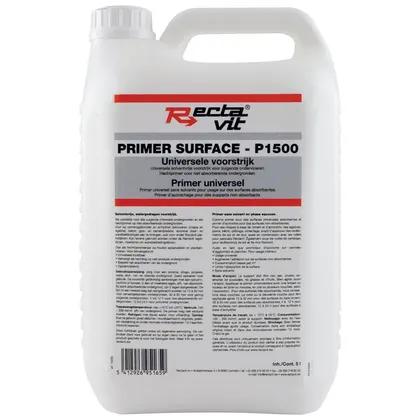
A primer is a base coat applied to the subfloor before gluing. Depending on the product, it does one or more of the following:
- Consolidate: a weak, sandy or dusty screed is strengthened at the surface and below, so the adhesive has a solid base.
- Bind dust: adhesive does not hold well on a dusty surface. The primer binds the fine dust.
- Block moisture: some primers, often epoxy or polyurethane based, form a barrier over a screed that still holds some moisture. Every primer has a maximum moisture level it can handle. Above that, it no longer helps.
- Repair and level: certain primers can be mixed with quartz sand to fill cracks or even out small irregularities.
- Control absorption: on a very absorbent base, the primer stops the adhesive from drying too quickly.
Adhesion promoter for smooth surfaces
On hard, non-absorbent surfaces such as tiles, natural stone or old lacquered bases, adhesive struggles to grip. An adhesion promoter makes the surface suitable for gluing. Proceed as follows:
- Check that all tiles are firmly bonded and the floor is flat.
- Degrease the surface thoroughly. All soap and care product residue must go.
- Sand or abrade the surface and vacuum up the dust.
- Apply the adhesion promoter according to the data sheet and observe the drying time before gluing.
Types of parquet adhesive
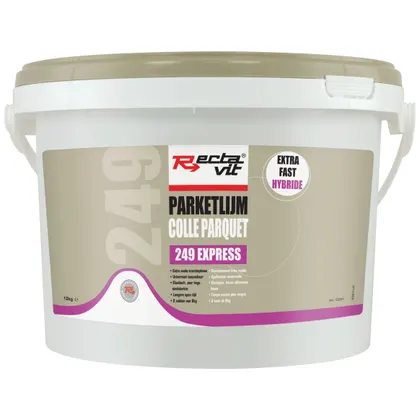
- MS polymer or silane adhesive: one-component, solvent-free and permanently elastic. Cures with moisture from the air. Suitable for most species, on screed, timber boards and, with the right preparation, tiles. A common choice with underfloor heating, because it absorbs the movement of the wood.
- Polyurethane (PU) adhesive: one or two-component. Very strong bond, hard-elastic. Suitable for larger and solid boards. Two-component adhesive needs accurate mixing and has a limited working time.
- Water-based dispersion adhesive: the water in it can make wood swell. Only suitable for certain smaller formats and species that are not sensitive to it, and only if the manufacturer allows it.
- Solvent-based adhesive: widely used in the past, now largely replaced by products that are healthier to work with.
How to choose
The choice depends on several factors. Go through them before you order:
- The subfloor: type, strength, flatness and residual moisture.
- The parquet: species, solid or engineered, width, thickness, length and sensitivity to moisture.
- Underfloor heating or cooling: choose an adhesive that is explicitly approved for it.
- The pattern: with herringbone and small elements, the adhesive must hold the pieces firmly in place.
- The parquet manufacturer's instructions: they sometimes require a specific type of adhesive.
Gluing well in practice
- Work within the adhesive's temperature range, usually from about 15 degrees subfloor temperature.
- Use the notched trowel specified on the data sheet. The notch size decides how much adhesive goes down.
- Only spread as much adhesive as you can cover within the open time.
- Press each board down well so the whole underside sits in the adhesive. Lift a board now and then to check the coverage.
- Remove adhesive from the surface immediately with the cleaner the manufacturer recommends. Once cured, it is much harder to get off.
- Let the adhesive cure before putting heavy loads on the floor, sanding it or finishing it.
The webshop stocks primers, adhesion promoters and parquet adhesives. Not sure which product suits your subfloor? Ask us before you start. Janssen Parketvloeren also lays glued floors itself.