
Parquet over underfloor heating
Parquet and underfloor heating work well together if you follow the rules: commissioning, species, installation, temperature limits and humidity.
A wooden floor over underfloor heating works perfectly well and gives a pleasant, even warmth. Wood is a living material, though: heated from below, it dries out faster and moves more than on an ordinary floor. With the right choices and a few firm rules, you avoid open joints, cupping and creaking.
Choose the right parquet
- Engineered (multi-layer) parquet is the first choice. Its cross-bonded layers keep the wood more stable than a solid board.
- Solid parquet is possible but needs more care. Choose narrower boards that are not too thick.
- Mind the ratio between width and thickness. Wide, thin boards are more likely to deform than narrower ones.
- Oak and several other species behave well. Beech and maple react strongly to changes in moisture and are less suitable.
- Check that the manufacturer explicitly approves the product for underfloor heating and, where relevant, underfloor cooling.
A correct floor build-up
From bottom to top, a typical build-up consists of the structural slab, a damp-proof layer, insulation, the heating pipes embedded in a screed (possibly reinforced), and then the parquet. The pipes must be fully embedded and evenly spaced, so that no local hot zones occur.
Commission the heating first, then lay
A new heated screed is run through a fixed heating-up protocol before any parquet goes on it. The temperature rises step by step, stays at maximum for a while and then comes down step by step. This dries the screed further and shows whether cracks appear. Ask the heating installer for the protocol and keep a written record.
- Wait until the screed has cured sufficiently according to the screed supplier.
- Carry out the heating-up protocol, even in summer.
- Have the residual moisture measured afterwards. Stricter limits apply with underfloor heating: as a guide about 1.8 percent CM for sand and cement and about 0.3 percent CM for anhydrite.
- Turn the heating down a few days before laying, so the floor surface is about 15 to 18 degrees.
Glued or floating?
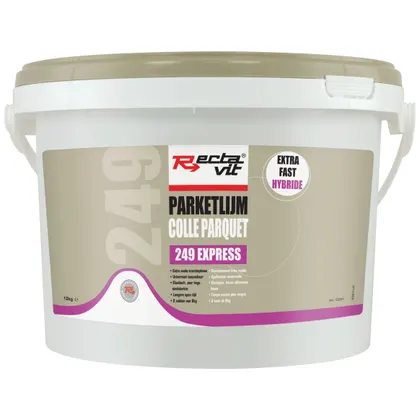
Full-surface gluing gives the best heat transfer, because there is no air between screed and wood. Use an adhesive suitable for underfloor heating, such as an elastic MS polymer adhesive. A floating installation is also possible, with an underlay of low thermal resistance. As a rule of thumb, keep the total thermal resistance of parquet and any underlay as low as possible, ideally below 0.15 m²K/W. The manufacturer lists this value on the data sheet.
After laying: warm up slowly
- Let the adhesive cure fully according to the manufacturer before turning the heating back up.
- Then raise the temperature gradually, about 1 to 2 degrees per day, to the normal setting.
- Do the same at the start of every heating season: never from cold to full power.
Temperature limits in daily use
- Limit the flow temperature of the water, as a guide to about 45 degrees at most.
- Keep the surface temperature of the parquet below about 27 degrees. That is comfortable underfoot as well.
- Avoid large temperature swings. A low, steady setting works better than switching hard on and off every day.
- Thick rugs and furniture without legs trap heat and raise the temperature of the wood locally.
Underfloor cooling
When cooling through the floor, the surface must never get so cold that condensation forms. Do not let the flow temperature drop too low and use controls with dew point monitoring. Without it, moisture can get into the wood and cause swelling and stains.
Humidity in winter
During the heating season, indoor air can become very dry. The wood then shrinks and small gaps may appear. These usually close again in the more humid months. Try to keep relative humidity between about 45 and 60 percent, with a humidifier if needed. A hygrometer in the room gives you a quick picture.
Leave it to a professional
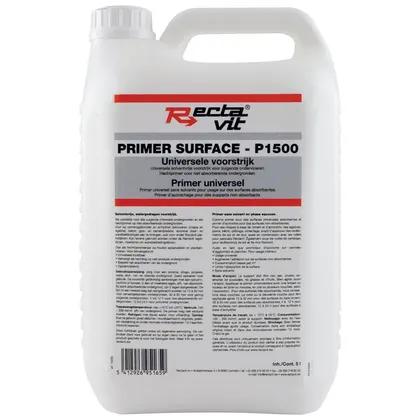
Parquet over underfloor heating is best laid by someone who measures moisture, checks the heating-up record and chooses the right adhesive and method. Janssen Parketvloeren lays parquet over underfloor heating and will advise you beforehand. In the webshop you will find adhesives and primers suitable for heated subfloors.